
Assays
RodentFlow knows 15 assays plus a custom table. For each assay it knows the arena, the phases, the zones and settings, the metrics with their definitions, the natural within-animal comparison and the chance level of a measure, where one exists. This page is the overview; the four category pages give the details.
| Assay | Category | From video | Phases | Main measure |
|---|---|---|---|---|
| Open field / center | Anxiety & affect | Rectangle or circle | — | Total distance; center time % |
| Elevated plus maze | Anxiety & affect | Plus maze | — | Open-arm time % |
| Light–dark box | Anxiety & affect | Rectangle | — | Light-box time % |
| Marble burying | Anxiety & affect | — | — | Marbles buried % |
| Sucrose preference | Anxiety & affect | — | — | Sucrose preference % |
| Y-maze | Learning & memory | Y-maze | — | Spontaneous alternation % |
| T-maze | Learning & memory | T-maze | — | Right first choice % |
| Novel object recognition | Learning & memory | Rectangle or circle | Training, Test | Discrimination index |
| Morris water maze | Learning & memory | Circle | Acquisition, Probe | Escape latency; target quadrant % |
| Barnes maze | Learning & memory | Circle | Acquisition, Probe | Primary latency; target quadrant % |
| Fear conditioning | Learning & memory | Rectangle | Training, Context test, Cue test | Freezing %; CS freezing % |
| Beam walking | Motor function | — | Beam (free text) | Traversal time |
| Gait analysis | Motor function | — | — | Hind stride length |
| Conditioned place preference | Reward & decision | Rectangle | Pre-test, Conditioning, Test | Preference score |
| Two-armed bandit | Reward & decision | — | Session / block (free text) | High-value choices % |
| Other / custom table | Other | — | free text | Any imported column |
Every assay can also be entered by hand or imported from a table (how).
Zones at a glance
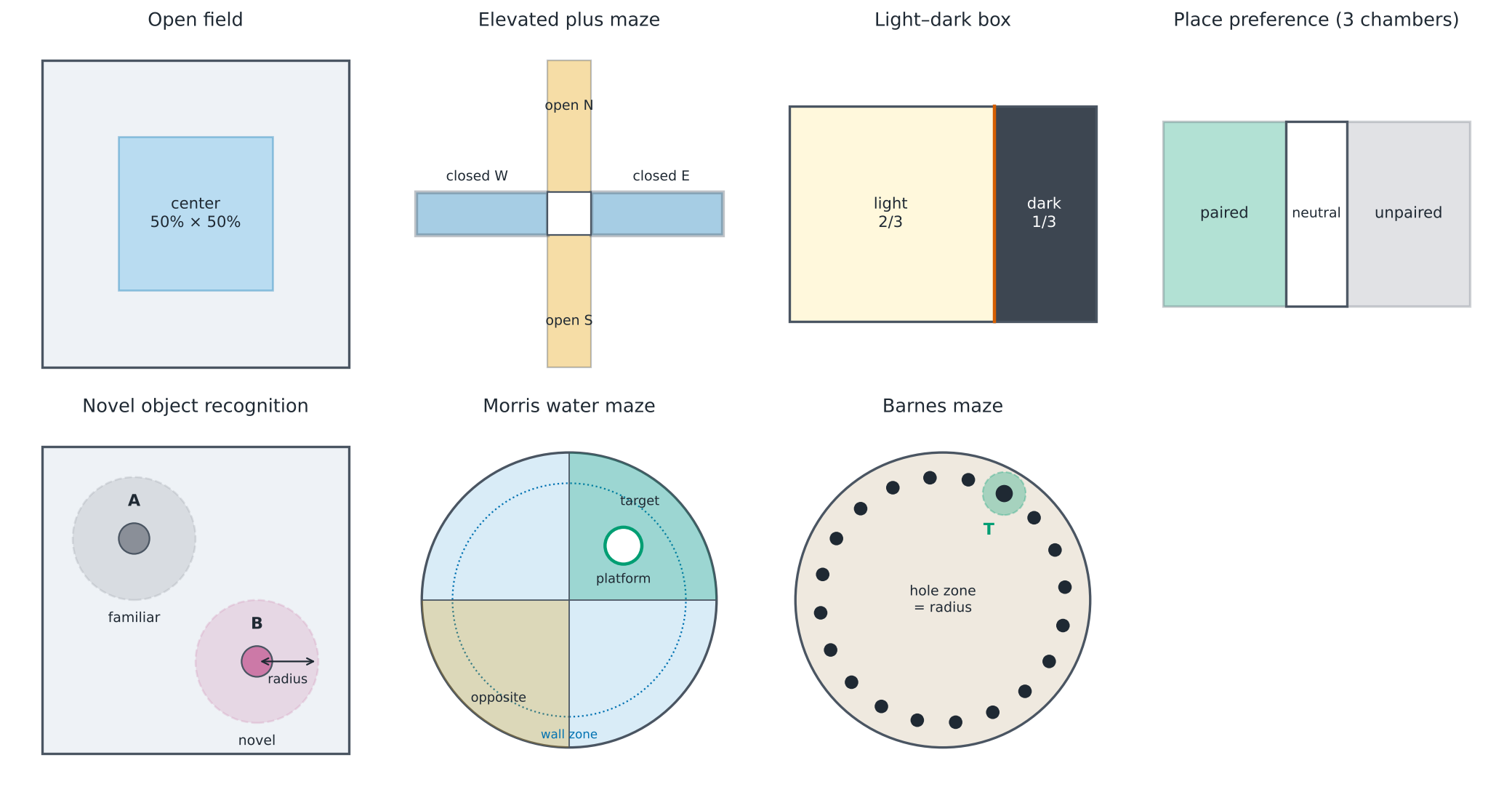
Rules shared by all video assays
These rules are explained in From positions to metrics.
- Sampling. Positions are sampled 10 times per second, and each sample stands for the time until the next one.
- Time in a zone counts only samples where the animal was detected. Percentages of zone time use the detected time as the denominator, unless stated otherwise.
- An entry into a zone is counted only after the animal has stayed in it for the entry criterion: 0.3 s by default, 0.25 s in the plus maze and the T- and Y-mazes, 0.5 s in the light–dark box and CPP, 0.2 s in the Barnes maze. Being in a zone at the start of the analysis is not an entry.
- A latency is the time from the start of the analysis window to the first entry. It is the window length if the animal never enters, and 0 if it starts in the zone.
- Distance adds up the steps between consecutive detected samples, so gaps in detection add no distance.
- The analysis window (Start after, Length) restricts every metric to part of the video, e.g. the first 5 minutes.
- Tracked samples % is the share of samples in which the animal was found. Results below 90 % carry a quality flag. The light–dark box, fear conditioning and the Barnes maze are exempt because the animal is expected to be hidden at times there.